Research note 01 · Claims & Evidence
How to test a sustainability claim before trusting the label
Turn a broad label into a bounded statement that can be checked against a source, method, and date.
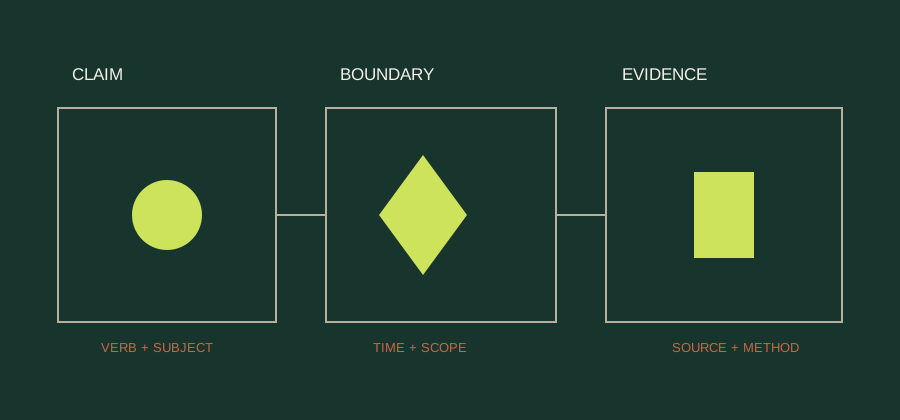
A sustainability label is often the beginning of a claim, not the evidence for it. Words such as “green,” “responsible,” “transition,” or “Paris aligned” can describe different objectives, methods, and time periods. The reader’s first task is to replace the label with a statement that can be tested.
This does not require a private model or a perfect score. It requires a clear subject, verb, boundary, source, and date.
Rewrite the claim as a sentence
Start with the exact words used in the product name, report, or marketing page. Then ask what those words say happened.
“Low carbon fund” might become: “The portfolio has lower financed emissions than a named benchmark as of the reporting date.” “Supports the transition” might become: “The strategy allocates capital to activities that meet a defined transition test.” These sentences are narrower. They also expose missing information.
Mark the verb. Does the claim say that the product excludes, selects, reduces, engages, finances, aligns, or measures? Each verb needs different evidence. An exclusion can be tested against holdings and a policy. A reduction needs a baseline, boundary, and later measurement. Engagement needs an activity record and an explanation of the intended result.
Draw the boundary
A number without a boundary can look more complete than it is. Record what the claim covers:
- the fund, selected holdings, issuer, or financed project;
- operations, value chain, or portfolio exposure;
- one reporting date or a change over time;
- absolute emissions, emissions intensity, revenue share, or another unit;
- reported data, estimated data, or a mixture;
- the benchmark, scenario, taxonomy, or internal rule used for comparison.
Then record what is outside the boundary. A product can report operational emissions while omitting a material value-chain category. A portfolio can have a low current intensity because it holds a different sector mix, not because its holdings reduced emissions.
Follow the evidence chain
Move from the public label to the document that defines it. A useful chain can include the product disclosure, methodology, holdings date, issuer report, data-provider method, and formal rule or standard. Record the version and date of each document.
For European financial products, the European Commission’s sustainable-finance disclosure overview is a useful primary starting point for the purpose and structure of the disclosure regime. It is not evidence that a specific product achieved a specific result. The product’s own current documents still need review.
Check whether the evidence matches the verb. A policy that permits engagement is not proof that engagement occurred. A target is not a measured result. A model estimate is not issuer-reported data. These items can all be useful, but they support different sentences.
Test comparability
Two products can use the same label while using different definitions. Before comparing their numbers, check reporting dates, currencies, portfolio coverage, emissions scopes, normalization units, benchmark construction, and treatment of missing data.
If these differ, do not force a direct ranking. State the difference and compare only the parts that share a method.
Record a result with limits
Finish with four lines:
- Claim: the narrow sentence you tested.
- Evidence found: the sources and dates that support it.
- Evidence missing: the source, boundary, or method that was not available.
- Conclusion: supported, partly supported, unsupported, or not comparable.
This result is more useful than a broad “good” or “bad” rating. It shows another reader what was checked and what could change the conclusion. A strong review makes the path from label to evidence visible. It also makes uncertainty visible when the path ends early.