Research note 04 · Stewardship
What counts as evidence of investment stewardship
Build an activity record that separates a stewardship policy, an investor action, and an issuer outcome.
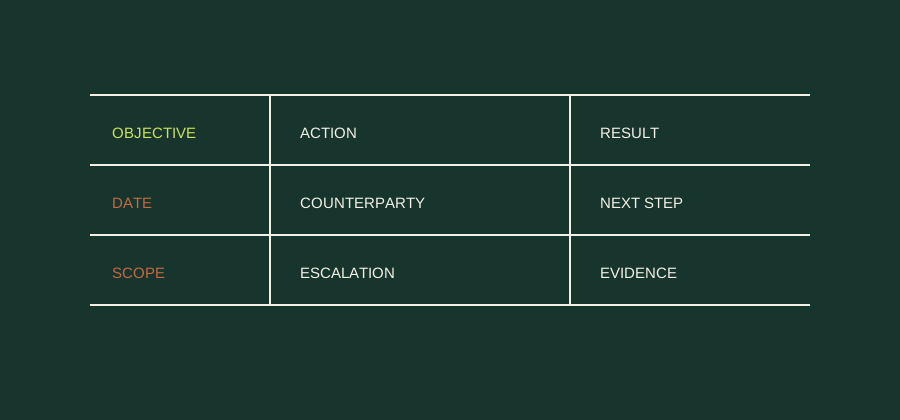
Stewardship claims often move too quickly from a policy to an implied result. A manager can have an engagement policy without using it in a specific case. It can hold a meeting without changing an issuer’s decision. It can contribute to a change without being the only cause.
A careful review keeps policy, activity, milestone, and outcome as separate evidence states.
Start with the stated objective
Write down the change the investor says it sought. “Discussed climate risk” is a topic, not an objective. A more testable objective might be a board-approved transition plan, a specific disclosure, a capital-allocation change, or a time-bound operational target.
Record why the issue was selected and which assets or issuers were in scope. A general commitment across a portfolio is different from a named engagement objective for one issuer.
Build the activity record
For each material step, record:
- date or reporting period;
- issuer, policy maker, or other counterparty;
- topic and specific objective;
- type of action, such as a meeting, letter, vote, filing, or collaborative initiative;
- who took part;
- response or evidence received;
- next step and escalation condition.
Private engagement can limit the public detail available. The reviewer can still ask whether the manager reports a consistent process, aggregate coverage, example selection method, and escalation rules. Lack of public detail is a limitation to record, not permission to invent a result.
Distinguish milestones from outcomes
A milestone shows progress in the engagement process. The issuer can acknowledge an issue, provide new information, or agree to review a policy. An outcome is a change in decision, disclosure, governance, target, or practice.
Neither one proves environmental or social impact on its own. A new target can later be missed. A disclosure can improve transparency without changing physical performance. State what changed and stop before the causal evidence ends.
Examine escalation
A stewardship policy is more informative when it explains what happens after limited progress. Escalation can include additional meetings, senior-level contact, collaborative engagement, public statements, voting action, shareholder resolutions, changes to portfolio exposure, or exit. The appropriate sequence depends on the strategy, jurisdiction, asset class, and client mandate.
Compare the published policy with the reported case. Was the stated escalation path used? If it was not used, does the source explain why? A flexible policy can be reasonable, but an unexplained gap reduces the strength of the evidence.
Read voting evidence in context
A voting statistic needs a denominator. Identify the number of eligible meetings or resolutions, markets covered, securities for which voting authority existed, and treatment of stock-lending or blocked markets. For votes against management, identify the subject and whether the vote followed the stated policy.
Do not treat one headline percentage as the full stewardship record. Voting is one tool. In fixed income and private markets, other rights and relationships can matter more.
Grade the claim, not the institution
Use a small evidence ladder:
- Policy only: a documented intent and process.
- Activity recorded: a dated action with a stated objective.
- Milestone observed: an intermediate response is documented.
- Outcome observed: a relevant decision or practice changed.
- Impact evidence: a later real-world result is measured, with causal limits stated.
This ladder avoids a false choice between “nothing happened” and “the investor caused the result.” It gives the reader a more exact statement: what evidence exists, at which stage, and what remains uncertain.
Stewardship is credible when the record connects objectives, actions, escalation, and results. The strongest report also tells readers what did not work and which engagements ended without the intended outcome.