Research note 03 · Climate Metrics
A practical map of financed-emissions data
Trace a portfolio emissions figure through exposure, company data, estimation, and attribution.
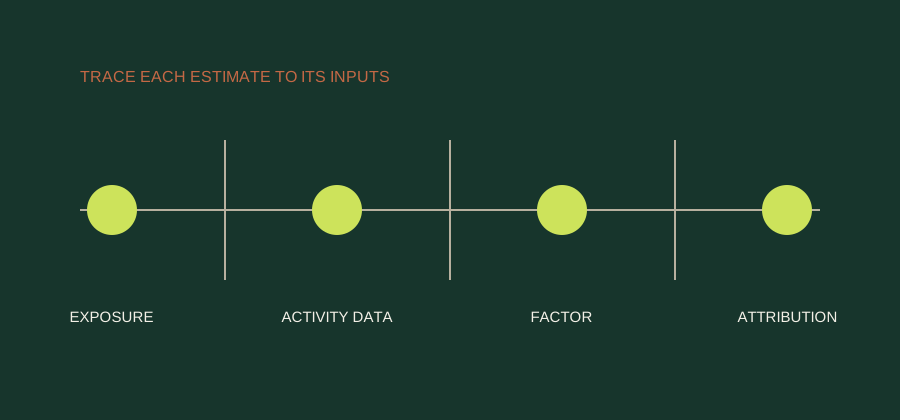
A financed-emissions total is a constructed measure. It combines financial exposure with company or asset emissions data and an attribution method. The final number can be useful, but it is not a direct reading from one meter. To understand it, trace each input and decision.
Begin with the question the metric is meant to answer. Is it an inventory of emissions associated with a portfolio at one date? Is it a change over time? Is it used to compare portfolios of different sizes? The answer determines which units and boundaries matter.
Map the financial exposure
List the asset classes included in the calculation. Public equity, corporate bonds, sovereign debt, mortgages, project finance, and commercial real estate do not all use the same inputs or attribution approach.
Record the portfolio date and value used. Holdings can change faster than annual emissions data. A portfolio measured at year end can be paired with company data from an earlier reporting period. That time difference does not make the result useless, but it must be visible.
Also record exclusions. Cash, derivatives, short positions, funds, or asset classes without an adopted method can sit outside the total. The coverage percentage should use a stated denominator so a reader can see how much of the portfolio was measured.
Separate reported and estimated emissions
For each holding or group, identify whether emissions came from an issuer report, a data vendor’s estimate, or a model based on sector and activity information. Do not combine these sources without a data-quality note.
Scope 1, Scope 2, and Scope 3 figures describe different parts of an emissions boundary. Check whether Scope 2 uses a location-based or market-based method. For Scope 3, note the categories included and whether the figure was reported or estimated. The same company can have several valid-looking totals because the scope and method differ.
If the source restates prior data, use the restated series for a time comparison where possible. Otherwise, a method change can appear as an operational change.
Inspect the attribution factor
Attribution assigns a portion of an entity’s emissions to the financial institution. The factor depends on the asset class and the financial values used in the method. A change in market value or enterprise value can change the attributed result even when the company’s physical emissions stay constant.
The Partnership for Carbon Accounting Financials publishes the Global GHG Accounting and Reporting Standard for measuring and disclosing financed emissions across asset classes. The current standard and its asset-class method are the primary reference for a PCAF-based claim.
Record the formula, valuation date, currency conversion, and treatment of negative or missing values. If the report gives only a total, look for the methodology appendix that defines these inputs.
Reconcile totals and intensities
Absolute financed emissions and an intensity metric answer different questions. Absolute values can rise when the portfolio grows. Intensity can fall because the denominator rises. Weighted average carbon intensity uses exposure weights and a company intensity measure; it is not the same construction as attributed financed emissions.
For a time series, create a small bridge:
- change caused by portfolio purchases and sales;
- change caused by issuer emissions;
- change caused by financial values or exchange rates;
- change caused by better coverage or a new model;
- change caused by a revised method.
The report may not disclose every bridge item. Record which changes can and cannot be separated.
Publish the data-quality boundary
Finish with coverage by asset class, proportion reported versus estimated, main estimation method, emissions scopes, reporting-date gap, and material exclusions. If a data-quality score is given, explain what its scale measures.
A financed-emissions number becomes more useful when its construction is visible. The aim is not to reject every estimate. It is to distinguish measured, reported, modeled, and attributed elements so the conclusion does not claim more precision than the inputs support.