Research note 05 · Research Methods
How to read a sustainability disclosure source stack
Move from a headline disclosure to the governing requirement, entity method, and underlying data.
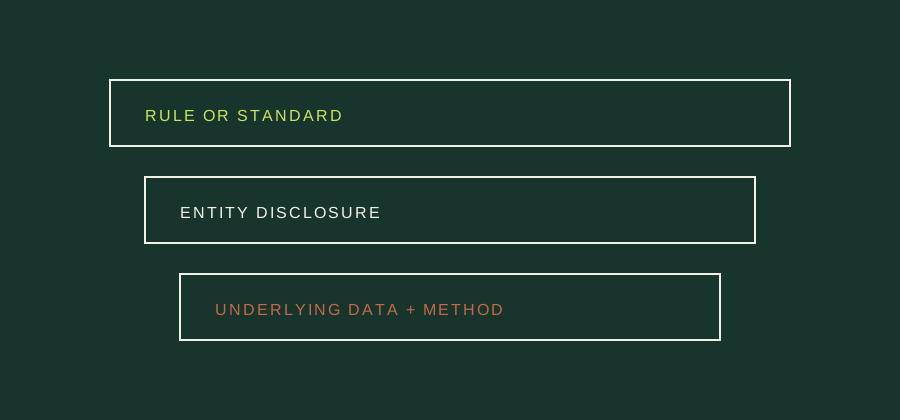
A sustainability report can cite a standard, use a data-provider method, and present a company estimate in the same paragraph. Those sources do different jobs. A reliable review separates them before it evaluates the conclusion.
Think of the evidence as a stack. At the top is the rule, standard, or voluntary framework. Next is the entity’s disclosure. Under it sit the methods, data, estimates, and controls used to produce the reported statement.
Read the governing source first
Identify the exact requirement that applies. Record its issuer, title, version, effective date, jurisdiction, and whether its use is mandatory, voluntary, or adopted through another rule.
Do not rely only on a report’s short description of the standard. Open the primary text and locate the paragraph or requirement that supports the claim. This helps you see qualifications that disappear in summaries.
For example, the IFRS Foundation’s pages for IFRS S1 General Requirements and IFRS S2 Climate-related Disclosures identify the standards and related materials. Whether they apply to a particular entity depends on adoption, jurisdiction, reporting basis, and the entity’s stated compliance.
Map the entity’s assertion
Find the basis-of-preparation statement. Does the entity claim full compliance, partial use, reference to a framework, or use of selected metrics? These phrases are not interchangeable.
Record the reporting entity, consolidation boundary, reporting period, currency, materiality approach, and location of incorporated information. A sustainability report can use a boundary that differs from the financial statements. If so, note the difference before comparing results.
Also identify where management judgment enters. Material topics, scenario assumptions, estimates, and forward-looking targets can depend on decisions that are not visible in the headline figure.
Follow each material metric
For a reported metric, make a source card with:
- metric name and unit;
- definition and formula;
- organizational and operational boundary;
- reporting and base periods;
- source systems;
- proportion measured, reported, and estimated;
- restatements or method changes;
- internal control or external assurance status.
If the same term appears in several documents, check that its definition stays constant. “Renewable energy,” “sustainable revenue,” or “assets under management” can use a scope that changes across reports.
Treat assurance as bounded evidence
An assurance statement can strengthen confidence in selected information. It does not automatically cover every claim in the report. Read the practitioner, standard used, level of assurance, subject matter, criteria, period, exclusions, and conclusion.
Limited and reasonable assurance provide different levels of confidence. A statement can also cover only named indicators. Do not attach its conclusion to pages or claims outside that scope.
Reconcile across the stack
Compare the governing requirement with the disclosure index. Then compare the disclosure with the method and data notes. Look for gaps in scope, definition, date, or unit.
For a forward-looking target, identify the baseline, target year, interim points, scenarios, planned actions, dependencies, and progress measure. A target’s existence is evidence of a stated plan. It is not evidence that the target will be achieved.
For fund names that use ESG or sustainability terms in the European Union, ESMA’s published fund-name guidelines are an example of a source whose effective dates, definitions, and application need to be read directly rather than inferred from a label.
Write a traceable conclusion
End the review with the applicable source, the entity’s stated basis, the data and method located, the assurance boundary, and the unresolved gap. Link each conclusion to a document and date.
The source stack prevents a common error: treating a familiar framework name as proof that the underlying claim was measured, controlled, and reported in the same way everywhere. A standard defines requirements. The entity applies them. Data and methods produce the number. Each layer needs its own check.